Why Your Tesla Demands More From Its Shock Absorber & How to Choose the Right One

Why does your Tesla ride so harshly over potholes? The culprit is battery weight. Discover why heavy EVs require specialized shock absorbers and how to choose the perfect aftermarket upgrade to restore your smooth, luxury ride.



If you’ve ever driven a Tesla Model 3 or Tesla Model Y over a sharp pothole, you’ve likely felt that signature thud—a stiff, bone-jarring crash that feels a bit too unrefined for a premium vehicle.
Many owners blame this harshness on aggressive engineering, but the root cause comes down to a simple reality: electric vehicles are heavy. That massive battery package entirely changes how the model interacts with the asphalt, placing immense stress on the entire suspension system.
If your daily ride feels overly harsh, or if you’ve crossed the 60,000-mile mark and notice your luxury sedan or crossover swaying more on the highway, it’s time to look closely at your vehicle shock absorbers (also called dampers or struts). Let's dive into why tesla vehicles require specialized engineering and exactly how you can pick the right shock absorber to get that smooth, cloud-like ride back.

Why do electric vehicles need special shock absorbers?
To understand what your tesla needs, think of its suspension like a pair of high-performance running shoes. If a 150-pound runner wears standard sneakers, they get great cushion. But if a 250-pound powerlifter goes running in those exact same shoes, the foam will instantly flatten out, and their joints take a beating.
That is exactly what happens to standard car parts on an EV. A Tesla Model Y weighs around 4,400 pounds, while a larger Model S or heavy SUV carries even more mass. A gas-powered passenger car or mid-size crossover of the exact same footprint typically weighs several hundred pounds less. Furthermore, all that weight is concentrated right under your feet in the floorboard energy storage unit.
Because of this heavy footprint, standard cars suffer from three major issues:
-
The "Trampoline" Bounce: When a heavy car hits deep dips or highway bumps, it wants to keep moving up and down like a heavy weight on a trampoline. The shock absorber has to work twice as hard to control that kinetic energy and stop the bounce instantly.
-
The "Nose-Dive" From Heavy Regenerative Braking: The second you lift your foot off the accelerator, the electric motor acts as a braking device, throwing all that heavy battery weight straight onto the front end. Cheap or worn dampers can't handle this constant shifting mass, causing excessive body roll and dipping during deceleration.
-
The "Magnifying Glass" on Road Debris: Traditional gas-powered vehicles make a lot of background engine vibration that naturally hides tiny imperfections on the road. Tesla vehicles are dead silent. Without a highly calibrated device to absorb micro-vibrations, every piece of small road debris feels like riding on sandpaper.
Why is the factory Tesla ride so bumpy and stiff?
From a manufacturing and mechanical perspective, factory tesla dampers (especially on models built before 2023) were intentionally designed to be very firm.
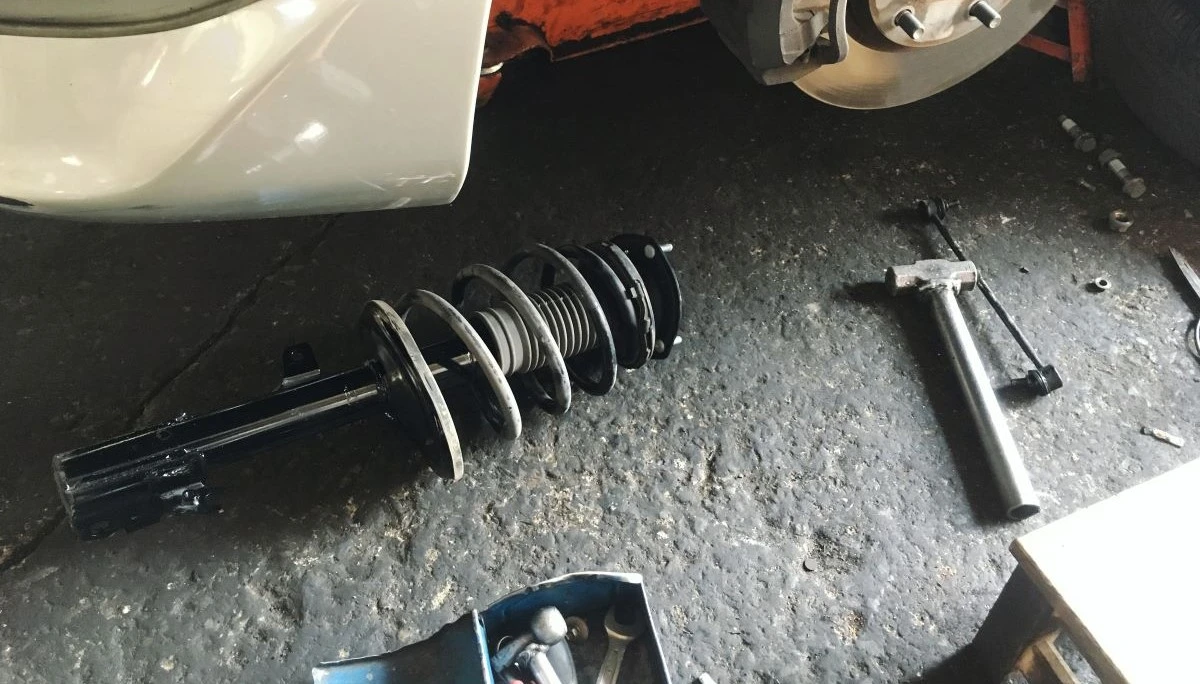
Because the chassis is carrying so much weight, engineers had to clamp down on the suspension movement to ensure safe cornering and handling. The coil spring on each wheel compresses first to support the vehicle mass and absorb initial hits. However, the shock must control that spring's rebound motion immediately afterward.
Tesla succeeded in making their vehicles handle like tight sports cars or a low-slung racing machine on track-smooth roads. However, the trade-off is a punishing everyday ride on real-world city streets. Over time, this constant harsh impact acts as a sign of trouble, accelerating your maintenance costs by wearing out nearby chassis components like control arms and rubber bushings much faster.

How do I choose the best shock absorbers for my Tesla?
When customers look for a replacement suspension package for tesla vehicles, it is not like buying budget parts for a standard gas vehicle or an older hot rod. You cannot just purchase a generic brand on sale and expect good results. To make an investment that truly protects your vehicle, use this simple roadmap:
Step 1: Identify your exact year and production trim
The company updates its hardware silently during production without changing the vehicle's name. A Rear-Wheel Drive model, a Long Range AWD, and a Performance trim all carry completely different weights and have different spring rates.
-
Action: Look at the white manufacturing sticker on your driver’s side door frame or check the "Software" menu on your main touchscreen to view your exact specifications before you ship or order any parts.
Step 2: Choose between comfort-focused setups and coilovers
Do you want a plug-and-play daily driver upgrade, or do you want to adjust ride height and stiffness?
|
What are you looking for? |
The Best Solution |
Popular Proven Brands |
Key Advantage & Benefits |
|
Fix the harshness on a budget |
OE-Spec Comfort Shocks |
MEYLE (Tesla Kit), T Sportline |
Typically uses a twin tube shocks design. Great for a softer everyday ride because it provides a wider fluid area to handle heavy battery weight smoothly. |
|
The ultimate luxury ride & adjustable height |
Comfort Coilover Kits |
KW Suspension (V3 Leveling) |
Combines the spring and damper into one matched unit. Gives you the advantage of manual stiffness adjustments so you can dial in a plush, European-style ride. |
|
Better handling and a lower look |
Performance Upgrade Kits |
Mountain Pass Performance, Unplugged Performance |
Designed for drivers who want sharper steering and reduced body roll during high-speed cornering without the harsh factory crash. |
What should I know before installing new shocks on Tesla vehicles?
If you are ready to upgrade your suspension, keep these three field-tested installation rules in mind to ensure long-term safety and performance:
-
Always replace shocks in matched axle sets: Because a Tesla’s weight is evenly balanced across the floorboard, replacing only one worn-out damper will confuse the vehicle's stability computer, triggering traction control errors during regenerative braking. Always replace shocks across the same axle, or do all four at once for balanced handling.
-
Inspect the control arms at the same time: The heavy weight of electric vehicles puts intense stress on front-end components. If your car has passed 50,000 miles and makes a squeaking noise over speed bumps, replace the upper control arms while your mechanic already has access to the suspension to save on duplicate labor fees.
-
Get a professional wheel alignment immediately: Changing your dampers changes how your tires make contact with the road. Because of instant electric motor torque, these cars can easily ruin a brand-new set of expensive tires in less than 5,000 miles if the alignment is off. A proper alignment ensures stable steering and optimal tire life.
Summary
Investing in the right shock absorber isn't just about modifying your vehicle—it’s a step toward sustainable energy enjoyment without sacrificing your daily comfort. By choosing a high-quality damping system engineered specifically to handle heavy electric mass, you can protect your chassis, save on long-term tire wear, and finally get the smooth, quiet, and refined ride your Tesla was always meant to deliver.


